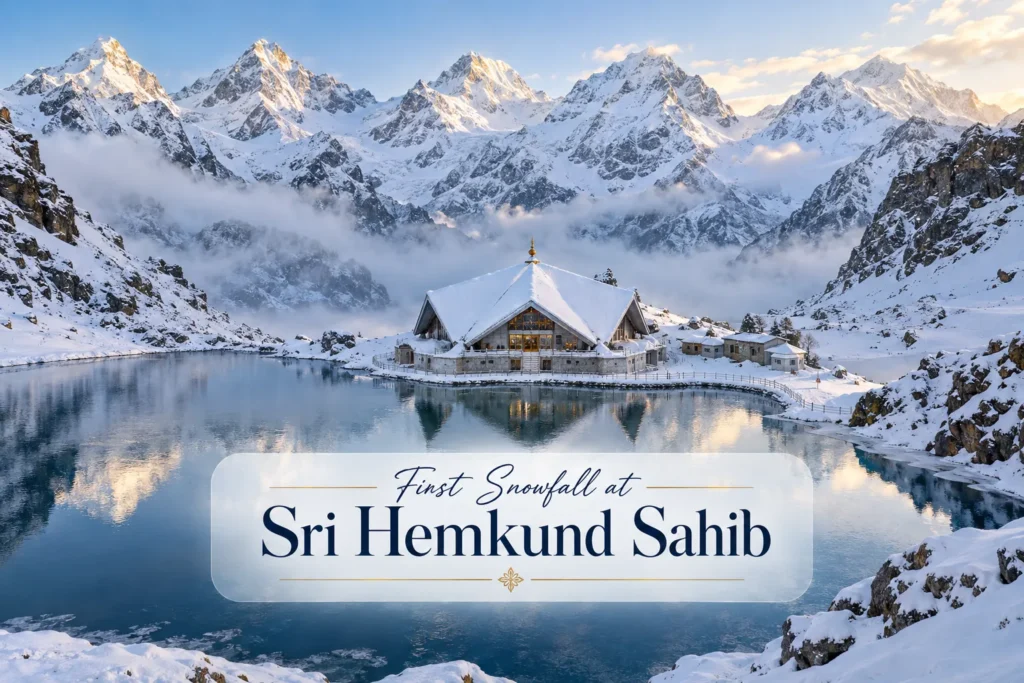
High in the mountains of Uttarakhand, Sri Hemkund Sahib has welcomed the season’s first snowfall. Fresh snow has covered the sacred gurdwara and its surrounding landscape, transforming the pilgrimage site into a peaceful Himalayan wonderland.
The snowfall was recorded on 18 September 2026. Videos from the site show the gurdwara surrounded by snow and mist, offering a striking glimpse of winter arriving early in the higher reaches of Uttarakhand.
Sri Hemkund Sahib is located in the Chamoli district of Uttarakhand at an altitude of more than 15,000 feet.
The sacred Sikh shrine stands beside a glacial lake and is surrounded by seven Himalayan peaks. The word “Hemkund” is generally interpreted as “Lake of Snow,” a name that perfectly matches the landscape during early snowfall.
The gurdwara is associated with Guru Gobind Singh Ji, the tenth Sikh Guru. It is believed that he meditated at this spiritually significant site.
The combination of faith, high-altitude scenery and a demanding mountain journey makes Hemkund Sahib one of India’s most distinctive pilgrimage destinations.
The first snowfall has changed the appearance of the entire pilgrimage area.
The roof and surroundings of the gurdwara have turned white, the nearby slopes are covered with fresh snow and clouds move between the surrounding peaks. The glacial lake beside the shrine adds to the calm and spiritual atmosphere.
For travellers, early snow creates a rare opportunity to witness Hemkund Sahib in its winter colours while the pilgrimage route is still operating. However, snow can also make the journey more physically demanding and unpredictable.
Visitors should not plan the trip simply to see the snowfall without first checking the official route and weather updates.
Hemkund Sahib remains inaccessible during winter because heavy snow covers the trekking route. The annual pilgrimage generally operates between late May and early October.
Published 2026 travel information indicates that the shrine is scheduled to close for the winter on 10 October 2026, subject to weather and official confirmation. Travellers should verify the closing date and daily route status before leaving.
Fresh snowfall may affect trekking conditions, pony operations, helicopter services and road movement. Authorities can regulate or temporarily suspend movement if the route becomes unsafe.
Reaching Hemkund Sahib involves a combination of road travel and trekking.
The nearest major airport is Jolly Grant Airport in Dehradun.
From the airport, travellers can hire a taxi or use available transport towards Rishikesh, Joshimath and Govindghat. The road journey is long and should normally be planned over one or two days rather than attempted in a rush.
The commonly used railway stations are:
Rishikesh is one of the closest practical railheads. Buses, shared vehicles and private taxis operate towards Joshimath and Govindghat, depending on road and weather conditions.
Govindghat is the principal road base for the Hemkund Sahib journey. It lies on the route towards Badrinath and can be reached from Rishikesh, Haridwar, Dehradun and other Uttarakhand destinations.
A common road route is:
Haridwar or Rishikesh → Devprayag → Rudraprayag → Karnaprayag → Joshimath → Govindghat
Mountain travel times can be longer than map estimates because of traffic, road repairs, landslides and weather.
The pilgrimage involves two main trekking sections.
Ghangaria is the base settlement for both Hemkund Sahib and the Valley of Flowers. Uttarakhand Tourism describes it as being reached by a trek of approximately 13 kilometres from Govindghat, although route measurements can vary based on the current starting point and local vehicle access.
Pilgrims normally spend the night in Ghangaria before continuing towards Hemkund Sahib.
The route from Ghangaria to Hemkund Sahib is approximately 5–6 kilometres, but it is steep and involves a major gain in altitude.
The return journey to Ghangaria is generally completed on the same day because overnight stays are not normally permitted at Hemkund Sahib.
Pony, porter and palki services may be available, but their operation depends on route and weather conditions.
Hemkund Sahib is not an ordinary hill-station visit. Its elevation creates a genuine risk of altitude sickness.
Possible symptoms include:
Do not ignore worsening symptoms. Descending to a lower altitude may become necessary, and professional medical assistance should be sought.
Pilgrims with heart, respiratory, blood-pressure or mobility concerns should consult their doctor before planning the journey.
Spend sufficient time acclimatising, walk slowly, remain hydrated and avoid competing with other trekkers for speed.
Visitors travelling after the first snowfall should take additional precautions:
A clear morning can change into fog, rain or snow within a short time at this altitude.
A practical packing list should include:
Keep luggage light. Carrying unnecessary weight makes the steep ascent considerably more difficult.
Registration is mandatory for pilgrims and vehicles undertaking the Char Dham and Hemkund Sahib Yatra. The process can be completed through the official Uttarakhand Tourism registration portal.
Keep digital and printed copies of the registration acknowledgement. Requirements can change, so check the latest government instructions before travelling.
Popular overnight stops include:
Ghangaria offers guesthouses, lodges, camps and gurdwara accommodation. Facilities are simpler than those found in regular tourist towns, and electricity or mobile connectivity can be inconsistent.
Accommodation becomes limited during busy pilgrimage dates. Advance booking is recommended, especially close to the closing period when many devotees may travel for the final darshan.
Ghangaria serves as the base for both destinations, making it possible to include Hemkund Sahib and the Valley of Flowers in one itinerary.
A practical journey may be planned as follows:
Haridwar or Rishikesh to Joshimath or Govindghat.
Govindghat to Ghangaria.
Hemkund Sahib darshan and return to Ghangaria.
Valley of Flowers excursion, subject to seasonal access and weather.
Ghangaria to Govindghat and onward journey.
Do not attempt to compress the trek into an unrealistic schedule. Rest and acclimatisation are important at this altitude.
The season’s first snowfall has made Sri Hemkund Sahib look extraordinarily beautiful. The white landscape, mist-covered mountains and sacred lake create a scene that feels almost untouched by time.
Yet the snowfall is also a reminder that the Himalayas must be approached with humility.
Weather can change quickly, trails can become slippery and the effects of altitude should never be underestimated. A successful pilgrimage depends on preparation, patience and respect for local instructions.
For devotees who travel responsibly, the journey to Hemkund Sahib can become much more than a trek—it can be a deeply spiritual and unforgettable experience.
Travelicious Journeys can assist with flights, railway tickets, hotel reservations, road transportation, yatra registration guidance and customised Uttarakhand itineraries.
Travelicious Journeys
Contact: +91 9090 99 6663
Website: www.traveliciousjourneys.in
+91 9090 99 6663
+91 9090 00 6663
traveliciousjourneys@gmail.com
operations@traveliciousjourneys.in
Office No. 105, First Floor, Hill Crest, Jarvari Rd, Pimple Saudagar, Pune, Pimpri-Chinchwad, Maharashtra 411027
Mon - Sat: 10:00 AM - 07:00 PM
Sun: Closed