🌧️ Sahyadris Become India’s Rainfall Hotspot
The Sahyadri range, also known as the Western Ghats, runs along Maharashtra’s western side and plays an important role in shaping the state’s monsoon.
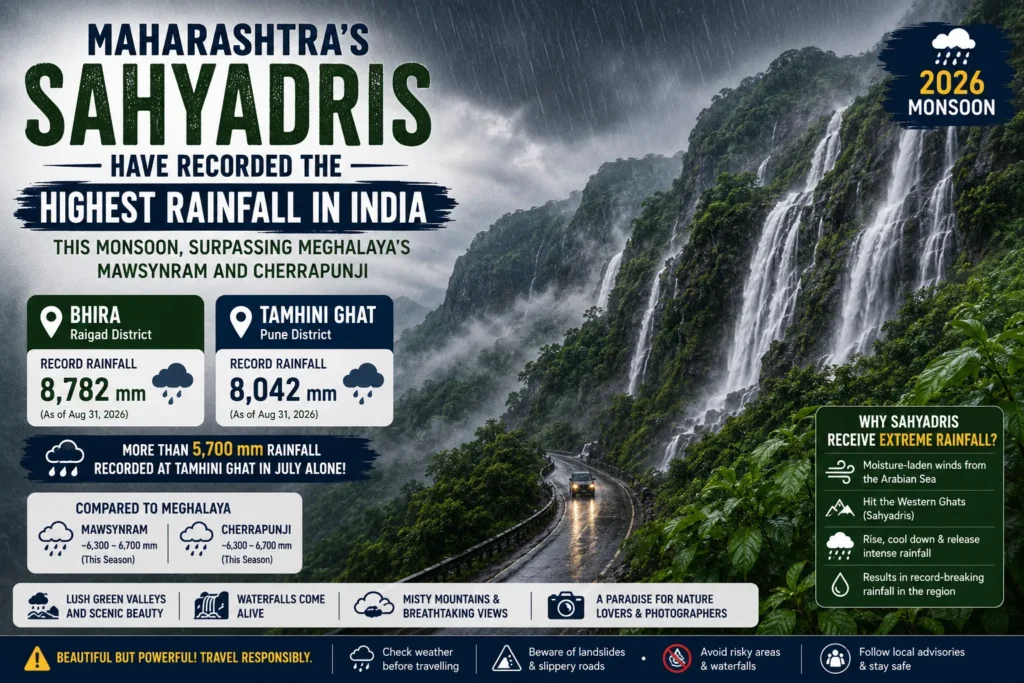
Among the most striking numbers this season are:
- Bhira: approximately 8,782 mm
- Tamhini Ghat: approximately 8,042 mm
- Tamhini recorded more than 5,700 mm during July alone
- Tamhini had already crossed the 6,000-mm seasonal mark by the end of July.
For comparison, reports indicate that Cherrapunji’s rainfall through the season was around 6,300–6,700 mm by the end of August, while Mawsynram was also in a similar range.
This makes the 2026 monsoon particularly remarkable for Maharashtra’s Sahyadri belt.
📍 Tamhini Ghat: The Star of Maharashtra’s Monsoon
Located in Maharashtra’s Pune district, Tamhini Ghat is already famous among travellers for its dramatic monsoon scenery.
During the rainy season, the mountain landscape transforms into a lush green corridor filled with:
- Numerous waterfalls
- Mist-covered hills
- Fast-flowing streams
- Dense forests
- Cloud-covered mountain roads
- Green valleys and viewpoints
This year, however, Tamhini’s rainfall has gone far beyond its usual reputation as a monsoon getaway.
Between June and July, Tamhini received more than 6,000 mm of rain, with July alone contributing approximately 5,710 mm.
🌊 Bhira Records Even More Rain
Another location that has attracted attention is Bhira in Raigad district.
According to the latest reported figures, Bhira has accumulated approximately 8,782 mm of rainfall, placing it above Tamhini in the reported 2026 season total.
Bhira is located in the Western Ghats and is known for its exceptionally wet conditions. The region’s geography makes it particularly susceptible to heavy rainfall when moisture-laden monsoon winds move inland from the Arabian Sea.
⛰️ Why Does Maharashtra’s Sahyadri Region Receive So Much Rain?
The explanation lies largely in geography and the southwest monsoon.
Moisture-rich winds arrive from the Arabian Sea and encounter the steep Western Ghats. As the air is forced upward along the mountains, it cools and condenses, producing intense rainfall on the western slopes.
This phenomenon is known as orographic rainfall.
The Sahyadris therefore act almost like a natural barrier, causing significant rainfall in areas close to the western slopes while locations only a relatively short distance away can receive considerably less.
Reports this season have attributed the exceptional rainfall to strong southwest monsoon winds and favourable pressure conditions over the region.
☔ An Extraordinary 2026 Monsoon Pattern
The rainfall record is even more interesting because India’s overall 2026 monsoon has not been uniformly wet.
Recent reporting indicates that India has been experiencing a comparatively weak monsoon season overall, with rainfall running below the long-term average and El Niño conditions influencing the broader weather pattern.
Against that national background, the extraordinary rainfall in parts of Maharashtra’s Sahyadris stands out even more.
It demonstrates how India’s monsoon can vary dramatically from one region to another.
🌿 What Makes the Sahyadris Special During Monsoon?
The heavy rainfall dramatically changes the landscape of the Western Ghats.
💦 Waterfalls Come Alive
Seasonal waterfalls that may be barely visible during dry months become powerful cascades during peak monsoon.
🌱 The Mountains Turn Deep Green
The combination of rain, cloud cover and vegetation creates the iconic emerald-green appearance associated with Maharashtra’s monsoon.
☁️ Misty Landscapes
Low clouds and mist frequently cover the mountain slopes, creating dramatic scenery for photographers and nature lovers.
🏞️ Rivers and Streams Swell
Heavy rainfall feeds the numerous streams, rivers and reservoirs originating in or around the Western Ghats.
📸 Popular Monsoon Experiences in the Sahyadris
The rainfall makes the region particularly attractive for nature-focused travel.
Popular experiences include:
- Scenic monsoon drives
- Waterfall visits
- Mountain photography
- Nature walks
- Trekking, where conditions are safe
- Valley viewpoints
- Forest experiences
- Exploring hill stations around the Western Ghats
Popular monsoon destinations in and around Maharashtra’s Sahyadri belt include Tamhini Ghat, Lonavala, Khandala, Mahabaleshwar and Malshej Ghat.
However, extreme rainfall can make some routes hazardous, so travellers should always check weather and road conditions before heading out.
🌏 Why This Matters Beyond Tourism
Heavy rainfall is not just a tourism story.
The Western Ghats are an ecologically important mountain system containing forests, rivers and diverse wildlife habitats. Rainfall in these mountains contributes to water resources across western and central Maharashtra.
At the same time, extreme rainfall can create challenges for:
- Roads and transportation
- Agriculture
- Local communities
- Reservoir management
- Landslide-prone areas
- Urban and rural drainage systems
Therefore, the 2026 rainfall provides an important reminder of both the benefits and risks of India’s monsoon system.
🌿 Maharashtra’s Monsoon Magic
The 2026 monsoon has given the Sahyadris a remarkable place in India’s rainfall story. With Bhira recording approximately 8,782 mm and Tamhini Ghat around 8,042 mm, parts of Maharashtra have experienced rainfall totals that have surpassed those reported from traditionally wetter Meghalaya locations this season.
For travellers, the result is a spectacular transformation: green mountains, roaring waterfalls, misty valleys and overflowing streams across the Western Ghats.
But the record-breaking rainfall is also a reminder that monsoon tourism requires caution. The Sahyadris can be breathtaking during heavy rain, but conditions can change quickly.
This monsoon, Maharashtra’s Sahyadris aren’t just looking greener—they are making headlines as one of India’s most extraordinary rainfall hotspots.