Vietnam has a way of surprising travellers.
One moment, you may be navigating Hanoi’s energetic streets filled with scooters, cafés and street-food stalls. A little over an hour later, you could be standing in a quiet village courtyard surrounded by hundreds of bright red incense bundles opening towards the sky like flowers.
This is Quang Phu Cau, a traditional incense-making village on the outskirts of Hanoi.
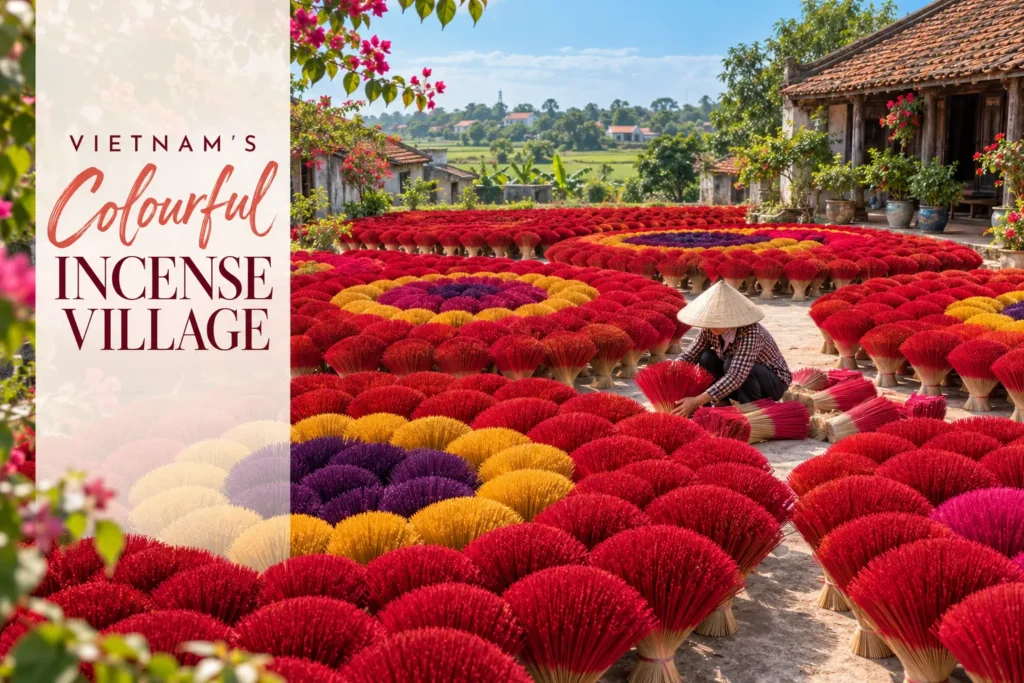
Photographs of the village often look almost too carefully arranged to be real. Bundles of red, pink, yellow and green incense sticks cover open courtyards in perfectly formed circles. From above, they resemble enormous flowers blooming under the Vietnamese sun.
Yet Quang Phu Cau is much more than a beautiful photography location. It is a working village where families have preserved the craft of incense making across generations. Every colourful bundle represents a process involving bamboo, fragrance, patience and the hands of local artisans.
For travellers looking beyond Vietnam’s familiar attractions, this village offers something increasingly valuable: an opportunity to see a traditional craft as part of everyday life.
Quang Phu Cau is located approximately 35 kilometres from central Hanoi, making it suitable for a half-day excursion from the Vietnamese capital. The village lies in the city’s wider rural outskirts, where Hanoi’s dense urban landscape gradually gives way to workshops, fields and quieter residential lanes.
Depending on traffic and your chosen mode of transport, the journey usually takes around one to one-and-a-half hours.
Its proximity to Hanoi makes Quang Phu Cau easy to include in a longer Vietnam itinerary. You can explore the village during the morning and still return to Hanoi in time for an afternoon walk around Hoan Kiem Lake, a meal in the Old Quarter or an evening street-food experience.
The village has become internationally recognised because of its striking incense displays. Rows of brightly coloured sticks are tied into bundles and spread across courtyards, roadsides and open spaces to dry in the sunlight.
The most familiar colour is red, a shade strongly associated in Vietnamese culture with happiness, prosperity and good fortune. However, artisans now also prepare incense sticks in colours such as pink, yellow, green and blue.
The arrangements naturally attract photographers. Seen from ground level, the sticks form dense walls of colour. From an elevated viewpoint, each bundle looks like a flower opening across the courtyard.
But behind those photographs is a genuine livelihood.
Villagers are not arranging decorative props solely for tourists. They are processing, drying, organising and preparing incense that will eventually be distributed to homes, temples and places of worship.
Understanding this difference changes the experience. You stop seeing the village merely as a colourful backdrop and begin appreciating it as a place where craft, commerce and cultural identity come together.
Incense holds a meaningful place in Vietnamese spiritual and family life.
It is commonly burned at temples, pagodas, household altars and ancestral shrines. Lighting incense can be an act of remembrance, gratitude, prayer or respect. It creates a symbolic connection between the present generation and those who came before.
Demand becomes especially strong around Tet, Vietnam’s Lunar New Year celebration. Families clean and decorate their homes, prepare offerings and honour their ancestors during the country’s most important annual festival.
As Tet approaches, incense production in Quang Phu Cau becomes busier. Courtyards fill with drying bundles, workshops work at a faster pace and the entire village seems to take on a deeper sense of activity.
For visitors, this period offers a fascinating look at how a traditional village prepares for one of Vietnam’s biggest cultural occasions.
Incense making requires several stages, and the process begins long before the bundles are placed outside to dry.
Bamboo is selected and cut into thin, uniform sticks. The lower sections are dyed—traditionally in red, although other colours are increasingly used—and then left to dry.
The upper portion is coated with a fragrant mixture. Ingredients vary according to the type of incense being produced and may include aromatic woods, herbs or other natural materials. While some parts of the craft were traditionally completed entirely by hand, machinery now helps local workshops manage larger production volumes.
After coating, the sticks are carefully spread into circular bundles and placed under the sun. Proper drying is essential, which is why the village looks most colourful on clear, sunny days.
Once dry, the incense is collected, checked, packaged and prepared for sale.
Watching this process gives visitors a far more meaningful understanding of the photographs for which Quang Phu Cau has become famous.
Quang Phu Cau is a working community rather than a conventional tourist attraction with one main entrance.
As you move through the village, you may encounter family-run workshops, bamboo sticks stacked beside homes, bundles being transported between production areas and residents carrying out their daily work.
Some areas can be explored freely, while certain private courtyards or specially arranged photography locations may charge an access fee. Reported charges generally range from around VND 50,000 to VND 100,000, depending on the workshop, photography arrangement and services provided. Fees and access conditions can change, so confirm them locally before entering.
Remember that many of the most attractive locations are also people’s workplaces and homes. Ask before entering private areas or taking close-up photographs of artisans.
A respectful conversation—even with the help of a translation app—can turn a quick photography stop into a genuine cultural interaction.
The most important factor is not simply the month—it is the weather.
Incense is typically placed outside to dry on sunny days. During rain, the bundles may remain covered or indoors, meaning the famous outdoor displays could be limited.
Check the weather forecast before making the journey.
The weeks leading up to Tet can be especially interesting because production increases to meet festive demand. However, this can also be a busy working period, so visitors should remain considerate and avoid interrupting artisans.
For photography, two time periods are particularly attractive:
Morning offers softer light, more comfortable temperatures and a comparatively peaceful atmosphere. You may also see residents beginning their daily work.
Late-afternoon sunlight creates a warmer glow and brings out the rich red, orange and pink tones of the incense sticks.
Lighting and production activity are never guaranteed, so a flexible schedule is useful. NDTV and local travel guidance both recommend sunny conditions and highlight the increased activity before Tet.
A private car is usually the easiest and most comfortable option, particularly for families, groups or travellers carrying photography equipment.
Booking a return journey with waiting time can be more convenient than trying to arrange transport from the village after your visit.
A guided tour is helpful for travellers who want to learn about the incense-making process rather than simply taking photographs.
Some tours combine Quang Phu Cau with other traditional craft villages around Hanoi, such as a conical-hat or lacquerware village. Check the exact itinerary, group size, included entrance charges and time spent at each location before booking.
Confident riders can travel independently by motorbike, but Hanoi traffic can be challenging for visitors who are unfamiliar with local road conditions.
Wear a proper helmet, carry an international driving permit where required and make sure your travel insurance covers motorbike use.
Public transport is the most economical option. Travel guidance lists bus number 91 from Yen Nghia Bus Station as one route serving the Quang Phu Cau area. Routes and schedules can change, so confirm the latest information locally before travelling.
Quang Phu Cau is wonderfully photogenic, but a little preparation can make the visit more rewarding.
Visit on a bright, dry day when incense is more likely to be displayed outdoors.
Carry a wide-angle lens or use your phone’s wide camera to capture the circular arrangements.
Use an elevated photography platform only when the workshop permits it.
Wear simple clothing in white, beige or another neutral shade so you stand out against the colourful background.
Avoid moving incense bundles without permission.
Do not block workers or pathways while composing photographs.
Ask before photographing people at close range.
Pay the requested photography fee respectfully when using a privately arranged courtyard.
The best image is not worth disrupting someone’s work or damaging the incense they have spent hours preparing.
The growth of tourism can provide additional income for local families, but it can also turn a living community into an uncomfortable photo set if visitors behave carelessly.
Keep your group small when possible. Speak quietly, follow instructions and avoid entering private homes without permission. If a workshop offers a demonstration, locally made incense or a small souvenir, making a genuine purchase is a practical way to support the craft.
Most importantly, take time to observe.
Watch how the artisans separate the sticks, arrange the bundles and move them as the sunlight changes. The village becomes more interesting when you look beyond its colours and notice the skill behind them.
Because Quang Phu Cau can be explored in half a day, it fits comfortably into a Hanoi itinerary.
After returning to the city, you could visit:
Hanoi Old Quarter
Hoan Kiem Lake
Temple of Literature
Ho Chi Minh Mausoleum complex
One Pillar Pagoda
Dong Xuan Market
Hanoi Opera House
A traditional water-puppet performance
Travellers particularly interested in Vietnamese craftsmanship can also combine the incense village with Bat Trang Pottery Village or Van Phuc Silk Village on a separate day.
Yes—especially if you are interested in photography, local traditions, handicrafts or cultural travel.
However, the experience is most rewarding when expectations are realistic. Quang Phu Cau is not a large theme park or a polished heritage complex. It is an active village, and the scale of the outdoor displays can depend on the weather, production schedule and time of year.
Come for the colour, but stay curious about the work.
The photographs may first attract you to Quang Phu Cau, but its real beauty lies in the rhythm of the village: bamboo being split, sticks being dyed, incense drying in the sun and generations of artisans continuing a craft that remains connected with Vietnamese spiritual life.
Travel becomes memorable when it reveals something that cannot be understood through famous landmarks alone.
Quang Phu Cau offers that kind of experience. It takes an everyday cultural object—an incense stick—and shows the patience, skill and tradition behind it.
Against the quiet countryside outside Hanoi, thousands of incense sticks open like colourful flowers beneath the sun. The sight is extraordinary, but it is the story behind those colours that makes the journey worthwhile.
From Hanoi’s historic streets and the colourful courtyards of Quang Phu Cau to Ha Long Bay, Ninh Binh, Da Nang and Hoi An, Travelicious Journeys can create a customised Vietnam holiday based on your travel style and budget.
For flights, hotels, sightseeing, transfers and personalised Vietnam itineraries:
Call: +91 9090 99 6663
Website: www.traveliciousjourneys.in
+91 9090 99 6663
+91 9090 00 6663
traveliciousjourneys@gmail.com
operations@traveliciousjourneys.in
Office No. 105, First Floor, Hill Crest, Jarvari Rd, Pimple Saudagar, Pune, Pimpri-Chinchwad, Maharashtra 411027
Mon - Sat: 10:00 AM - 07:00 PM
Sun: Closed